
Find the contamination before it reaches the consent limit.
Routine laboratory analysis tells you what you asked it to look for. It does not tell you that something unexpected entered the intake at two in the morning, and it does not tell you in time to divert the flow. Grab sampling has the same blind spot, since a daily average smooths out the short, sharp events that breach a permit.
Greenson brings two complementary technologies to Malaysia. Bioluminescent biosensor testing responds to the overall toxicity of a sample, including compounds you have not specifically targeted. Voltammetry measures trace metals directly at microgram-per-litre levels and names which metal is present.
Both are available as continuous on-line analysers, as laboratory bench instruments, and as portable units carried to the sample. The portfolio is not on-line only, so whichever way you work, there is an instrument that fits.
Continuous Monitoring
Installed once. Watching the water while nobody is on site.
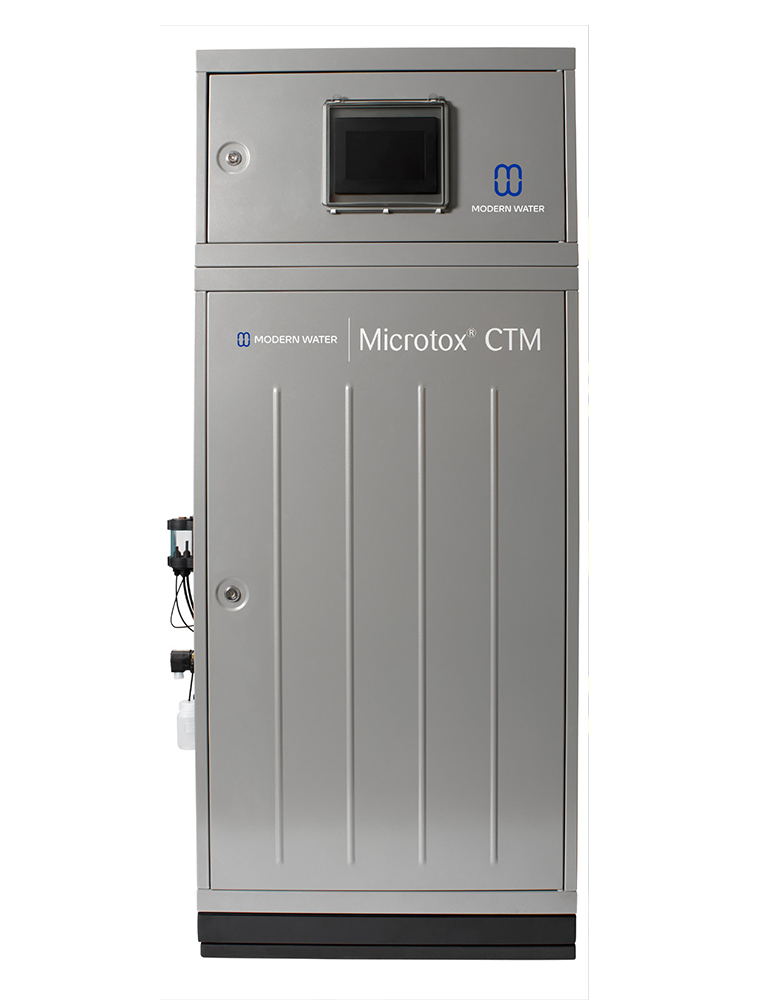
Microtox® CTM
A site-based analyser that measures the chemical toxicity of a water source continuously rather than at intervals. Other on-line toxicity monitors take an intermittent sample and return one result every fifteen to thirty minutes. The CTM takes two measurements per second, which materially reduces the chance of a brief event passing unrecorded.
- Four-week autonomous operating cycle with no manual intervention between monthly maintenance
- Responds to metals, pesticides, fungicides, herbicides, chlorinated solvents and industrial chemicals
- Detects synergistic toxicity events, so harmful combinations show up without running a suite of individual tests
- Diagnoses and reports its own system faults
- Broad-range detection whether or not the source of contamination is known in advance
It never stops looking. Most on-line toxicity monitors take a sample, test it, and report once every fifteen to thirty minutes. Anything that passes the intake between those tests is not recorded. The CTM measures twice a second, so a contamination event that lasts a minute is still a contamination event you see.
Key specifications
| Measurement principle | Bioluminescent bacteria biosensor |
|---|---|
| Measurement frequency | Two measurements per second |
| Sample requirement | 100 to 200 ml/min at ambient pressure |
| Sample temperature | 5 to 35 °C |
| Operating cycle | 4 weeks autonomous |
| Maintenance | Typically 2 hours per month |
| Communications | Ethernet, USB |
| Enclosure | 1250 x 750 x 365 mm (H x W x D), aluminium |
| Weight | 70 kg approx. |
| Certification | CE, RoHS, WEEE |
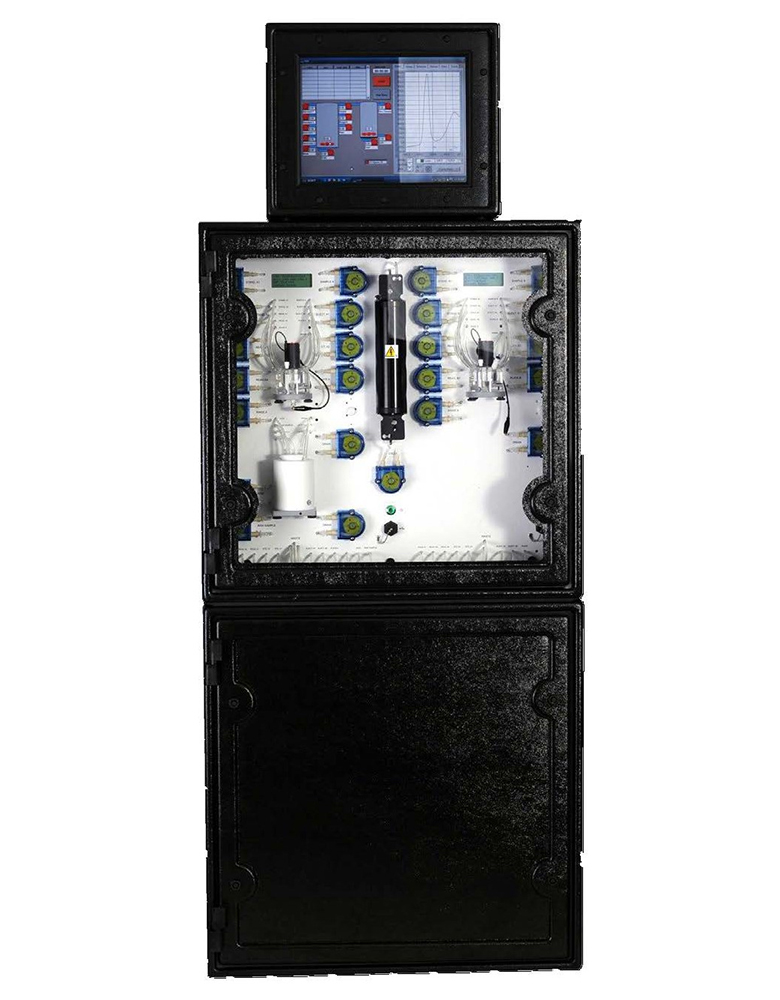
MicroTrace™ OVA7100
Where the CTM answers whether the water is toxic, the OVA7100 answers which metal is present and at what concentration. It uses voltammetry, an internationally accepted alternative to sending samples away for laboratory analysis, and runs unattended at a remote intake, a process stream or a discharge point.
- Configurable for up to 23 different metals, with up to six measured in a single cell unit
- Dual-cell configuration adds a second analytical cell for up to ten metals in one instrument
- Detection at single figure microgram-per-litre levels, typically 0.5 to 5 µg/l
- High frequency round-the-clock measurement isolates short events that daily average sampling misses
- Colour and turbidity do not affect the method
- Connects to the control room for automatic dosing adjustment or flow diversion on alarm
- Solid electrodes with no hazardous mercury drop electrode
One instrument instead of several. A discharge permit usually sets limits on more than one metal. If each analyser measures a single metal, a plant that reports on eight of them needs eight instruments, eight sample lines and eight sets of maintenance. The dual-cell OVA7100 measures up to ten metals in one enclosure.
Key specifications
| Measurement principle | Voltammetry, anodic and cathodic stripping |
|---|---|
| Metals configurable | Up to 23 |
| Metals per cell unit | Up to 6 |
| Dual-cell configuration | Two analytical cells, up to 10 metals in the same instrument |
| Detection range | Typically 0.5 to 5 µg/l |
| Voltammetry range | -2 V to +2 V |
| Sensitivity | 1 nA |
| Variation (% CV) | 5 to 10% |
| Communications | LAN Modbus TCP/IP, wireless, USB |
| Operating temperature | 5 to 60 °C |
| IP rating | IP65 |
| Dimensions | 1400 x 482 x 400 mm (H x W x D) |
| Mass | 22 kg (analyser) |
All values depend on the metal or metals being analysed and the nature of the sample.
Laboratory Instruments
Bench testing for compliance, treatment efficiency and research.
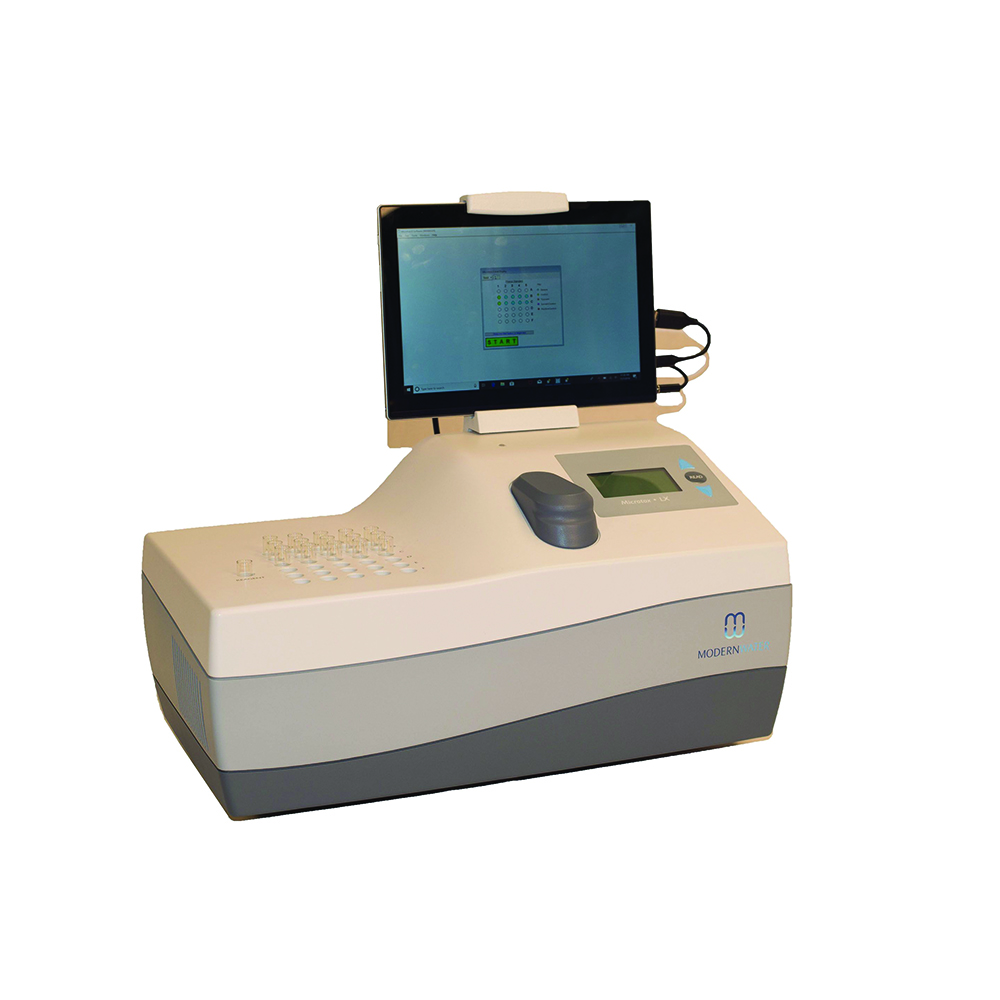
Microtox® LX
A bench analyser for rapid acute toxicity testing, built on the same bioluminescence method as the rest of the Microtox range. Results are available in as little as fifteen minutes after initial sample preparation, against the ninety-six hours a conventional bioassay can require.
- Sensitive to thousands of simple and complex chemicals
- Automatic colour correction adjusts results for sample turbidity and can be switched off when not needed
- Actively cooled reagent, incubator and read wells hold temperature stable across a run
- Standard protocols include Basic Toxicity, Screening, Comparison, Confirmation, SOLO Screening, Solid Phase and WET
- Runs to ISO 11348-3, ASTM D5660 and DIN 38412 reference methods
- Results correlate closely with conventional bioassay tests such as fish and daphnia
An answer the same morning, not the same week. A conventional bioassay can take up to ninety-six hours. By then the batch has moved on and the decision has been made without it. The LX returns a result in as little as fifteen minutes, quick enough to hold a discharge, adjust a dose, or re-test before anything leaves the site.
Backed by the published record. Speed is only useful if the result is trusted. Microtox has been the subject of over 800 peer-reviewed papers across pharmaceuticals, petrochemicals and ecotoxicology, so a result from the LX rests on a body of published work a regulator or a client can go and read.
Key specifications
| Measurement method | Bioluminescence |
|---|---|
| Light source | Proprietary fully dynamic photomultiplier |
| Time to result | From 15 minutes after sample preparation |
| Dimensions | 45.7 x 25.4 x 43.2 cm |
| Weight | Approx. 9 kg |
| Display | 7 in colour touchscreen tablet, Windows 10 |
| Connectivity | USB, WiFi, Bluetooth |
| Room temperature | 15 to 30 °C |
| Power | Auto-ranging 100-240 V AC, 50/60 Hz, 200 W |
| Accreditation | Manufactured under ISO 13485 with 100% lot traceability |
Portable & Field Instruments
Take the instrument to the sample, not the sample to the laboratory.
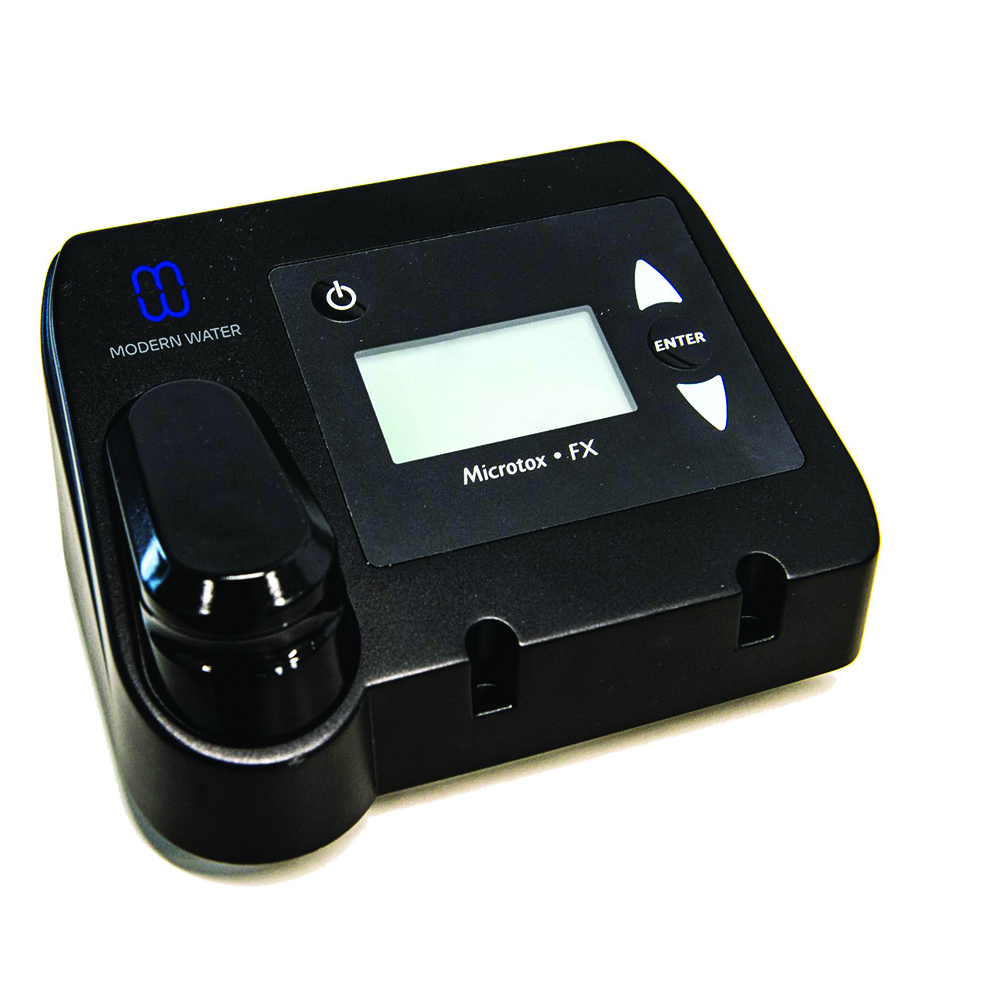
Microtox® FX
A one-kilogram field instrument combining two detection modes in a single unit. Acute toxicity screening covers toxic chemicals, and ATP measurement covers microbial contamination, which together address the two most probable classes of agent in a drinking water emergency or a chemical spill.
- Reliable results five minutes after initial sample preparation
- Sensitive to thousands of simple and complex chemicals
- Battery life of eight to ten hours in typical use, so a full sampling day does not depend on mains power
- Lightweight with a sturdy field carrying case
- Stores approximately 600 reads for USB download
Key specifications
| Test modes | Toxicity (Q-Tox and B-Tox) and ATP measurement |
|---|---|
| Time to result | 5 minutes after sample preparation |
| Size | 20 x 18 x 10 cm |
| Weight | 1 kg |
| Battery life | 8 to 10 hours typical use |
| Operational temperature | Instrument 0 to 40 °C, reagent 10 to 28 °C |
| Test durations | 1 to 60 minute exposure |
| Repeatability | <20% coefficient of variation |
| Data storage | Approx. 600 reads, USB download |
| Accreditation | Manufactured under ISO 13485 with 100% lot traceability |
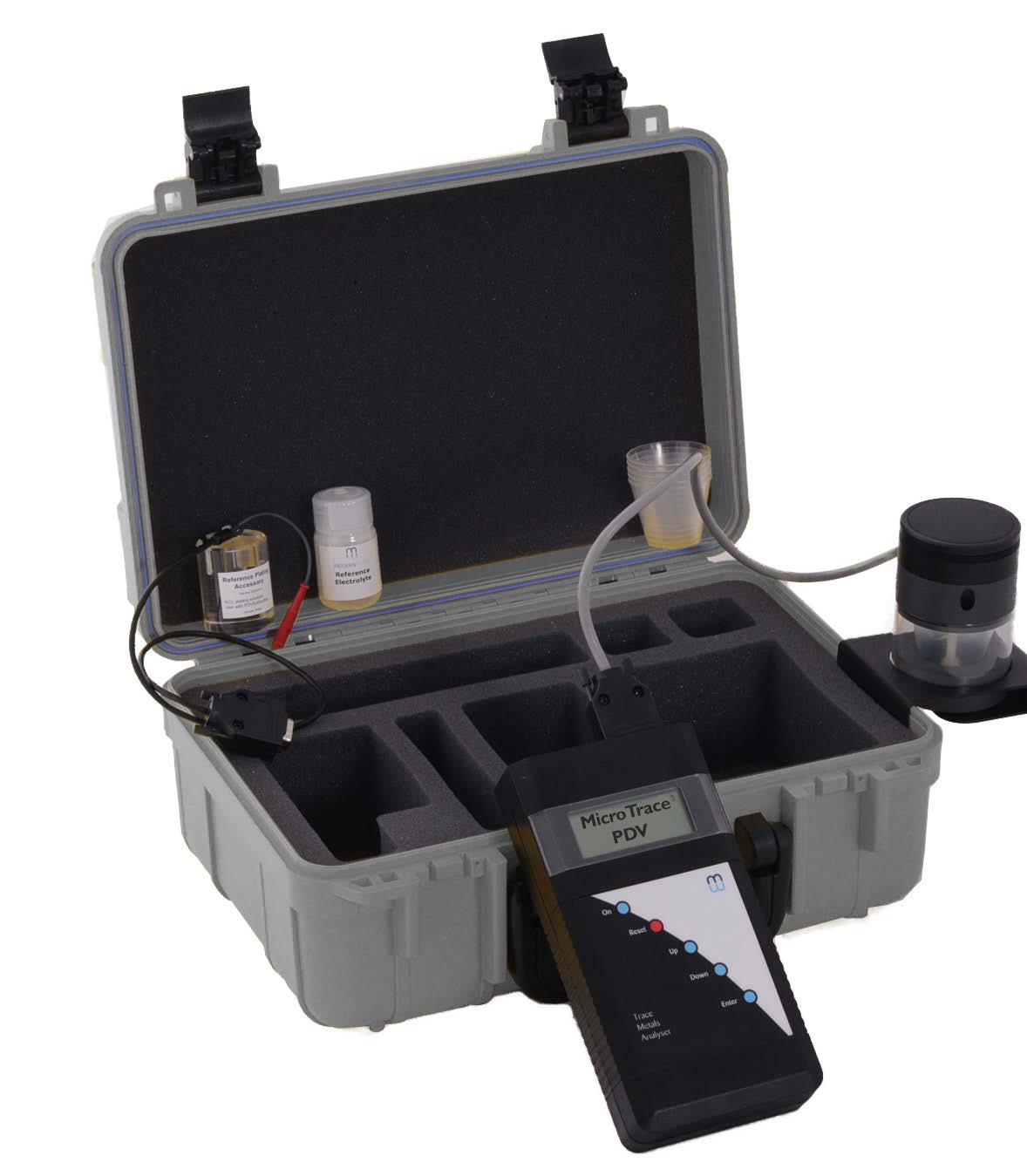
MicroTrace™ PDV6000ultra
The field counterpart to the OVA7100, using the same voltammetric method in a case you can carry to the sample. That changes how a site investigation works. Instead of taking a fixed number of samples and waiting a fortnight for results, you take a reading, move upstream, take another, and locate the source in a single visit.
- Configurable for up to 24 different metals in a single instrument
- Analyse in the field or the laboratory down to 0.5 µg/l, below drinking water regulations for many target metals
- Supplied with a tablet running preloaded analysis menus and step by step instructions
- Runs on AA batteries, a DC transformer or mains, so remote sites are not a problem
- Speciation of selected metals by lability and oxidation state
- Correlates well with laboratory methods such as AAS and ICP-MS at much lower capital and operating cost
Find the source before you leave the site. Send samples to a laboratory and you get numbers back two weeks later for the points you happened to pick. If the contamination was somewhere else, you go back and sample again. The PDV6000ultra gives you a reading on the spot, so you can test, move upstream, and test again until you find where the metal is coming from.
Key specifications
| Measurement principle | Voltammetry, anodic and cathodic stripping |
|---|---|
| Metals configurable | Up to 24 |
| Detection range | From 0.5 µg/l depending on metal |
| Voltammetry range | -2.0 V to +2.0 V |
| Sensitivity | 2 nA |
| Variation (% CV) | 5 to 10% |
| Power supply | AC 110-240 V, DC 8-12 V, or 4 x AA batteries |
| Dimensions | 360 x 270 x 155 mm (L x W x D) |
| Communications | USB |
| Packing | Sturdy water-proof carry case |
All values depend on the metal or metals being analysed and the nature of the sample. Detection limits quoted are based on clean water samples.
Where these instruments are used
The choice between a toxicity biosensor and a voltammetric metals analyser depends on the question being asked. If the concern is an unknown or a mixture, toxicity screening responds to the sample as a whole. If the concern is a named metal against a permit limit, voltammetry gives the concentration. Many sites run both.
Drinking water
- Raw water intake protection
- Source, in-process and finished water screening
- Distribution network monitoring
- Response after a suspected contamination incident
Municipal wastewater
- Influent toxicity screening before biological treatment
- Treatment efficiency and process control
- Final effluent monitoring against consent limits
- Identifying trade effluent sources within a catchment
Industrial
- Electronics and semiconductor wastewater plants
- Metal finishing, plating and foundry effluent
- Mining, smelting and metals processing streams
- Power generation and flue gas condensate
Environmental
- Rivers, lakes, reservoirs and seawater
- Groundwater monitoring and natural attenuation
- Storm water runoff
- Soil and sediment evaluation
Site investigation
- Tracing contamination back to its source
- Contaminated land characterisation
- Remediation decisions made on site
- More sample points without laboratory cost
Research and other
- Academic and ecotoxicology research
- Food and feed analysis
- Pharmaceutical and personal care product testing
- Drilling fluids and drilling muds
Request the catalogue
Full specifications and application notes for the toxicity and trace metal range. Tell us the parameter you need to monitor and where, and we will point you to the right instrument rather than the largest one.
Request Catalogue